

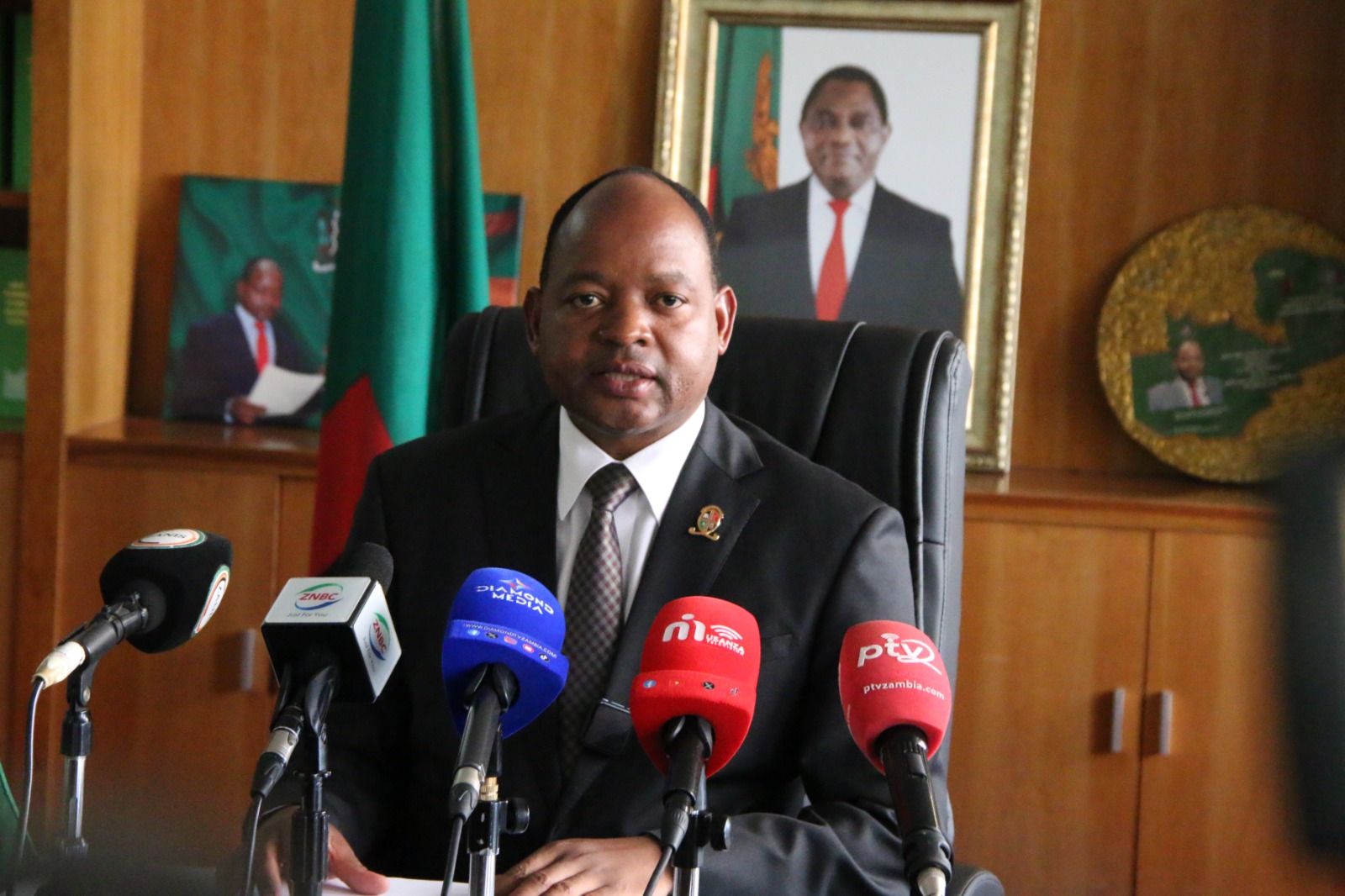
Cabinet approved the revised 2026 Budget, in order to address higher-than-anticipated expenditure requirements in the 2026 fiscal year.
Cabinet has however, noted with concern, that the recent conflicts in the Persian Gulf region have affected Zambia, particularly through increased costs associated with fuel imports.
To mitigate the impact on citizens, the government recently suspended Value Added Tax and Customs and Excise Duties on fuel.
Chief Government Spokesperson, Cornelius Mweetwa, states that while this measure has provided relief to consumers, it has also resulted in a reduction in domestic revenues, thereby heightening fiscal pressures and widening the financing gap.
In a statement issued to ZANIS on decisions made by Cabinet at the 5th Cabinet meeting held on Thursday, 9th April, 2026, and chaired by President Hakainde Hichilema, Mr Mweetwa, who is also Minister of Information and Media, noted the need to accommodate the higher-than-projected public sector wage bill, following the conclusion of the 2026 salary adjustments and improved conditions of service for public service employees.
He indicated that the 2026 Budget realignment is, therefore, intended to restore fiscal balance by accommodating unplanned expenditures and adjusting to revenue shortfalls, while ensuring the continued delivery of public services and implementation of key government policies and programmes.
And, Mr Mweetwa added that Cabinet further approved in principle, the introduction of a Bill in Parliament to amend the Penal Code Act, Cap 87 of the Laws of Zambia, in order to strengthen the penalty for the offence of theft of stock.
He says Cabinet has found it necessary to amend the Penal Code Act, to provide for a stiffer penalty for the offence of theft of stock.
Mr Mweetwa observed that currently, the Penal Code Act 2 provides for a penalty for the offence of theft of stock for a first, second and subsequent offender.
He added that however, the penalty is not adequate to deter would-be offenders and to address rising cases of theft of stock.
The Minister pointed out that once the Bill is enacted, it will ensure that the legal framework remains effective in deterring would-be offenders, providing retribution and combating rising crime.
Meanwhile, Mr Mweetwa indicated that Cabinet received a briefing by a Vietnamese delegation, led by the former Vietnamese Minister of Agriculture, Cao Duc Phat, on Vietnam’s transformation from subsistence farming into one of the world’s leading agricultural exporters.
Mr Mweetwa said Dr Phat, in his presentation, indicated that the agricultural reforms in Vietnam were driven by strong financing mechanisms, investment in irrigation and rural infrastructure, as well as the rapid adoption of digital technologies.
He added that the reforms resulted in the transformation of Vietnam from one of the poorest countries into becoming one of the world’s leading producers of rice and coffee, with agricultural exports reaching approximately US$70.1 billion in 2025.
Based on the briefing, the Minister said the Cabinet noted that Vietnam’s agricultural success offers practical and actionable lessons for Zambia and that lessons from Vietnam’s experience will be adapted to the country’s local context to enhance food security, improve farmer incomes, boost exports and generally, the country’s economic development.
Mr Mweetwa stated that the Cabinet has since called for cooperation with Vietnam to be elevated to a formal economic partnership that is focused on trade, investment, technology transfer, and skills development.