
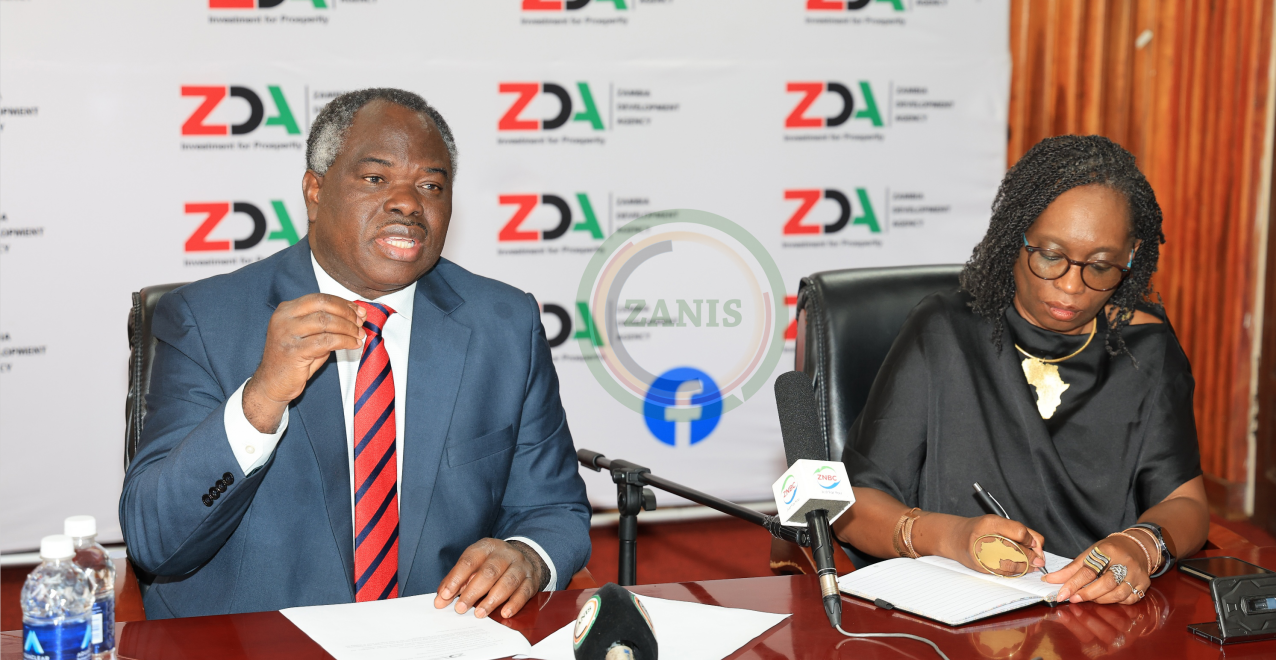
Zambia Development Agency (ZDA) Director General Albert Halwampa has announced that Zambia will, from February 2nd to 5th, host the Continental Energy and Infrastructure Investment Forum (CIF), marking the first time the forum is being held outside the Republic of South Africa.
Mr Halwampa says the hosting of the forum is a major milestone that reflects Zambia’s growing regional and global investment profile and the country’s readiness for accelerated economic growth.
Speaking during a media briefing, Mr Halwampa has stated that the forum aligns with the investment-driven agenda being championed by President Hakainde Hichilema, aimed at promoting trade, investment and economic transformation.
He has noted that South Africa remains a key trade and investment partner and that CIF will provide an important platform to deepen cooperation in sectors such as energy, infrastructure, mining and agriculture.
The ZDA Director General said the energy sector will take centre stage at the forum, following the recent drought that exposed Zambia’s energy deficit.
“We currently have over 10,000 megawatts of power projects seeking financing, and the forum provides a timely opportunity to connect independent power producers with financiers, including the Development Bank of South Africa, to unlock financial closure,” Mr Halwampa said.
He indicated that Zambia is also pursuing a major expansion in renewable energy, particularly solar and wind, to boost generation capacity.
Mr Halwampa further explained that Zambia aims to increase installed power generation from 3,800 megawatts to 10,000 megawatts, leaving a gap of 6,200 megawatts, which requires urgent investment.
He emphasised that the forum is focused on delivering tangible deals and transactions, particularly in the energy sector, where several power purchase agreements are already in place and only require financial closure.
Mr Halwampa said Zambia’s improved macroeconomic environment has strengthened investor confidence, citing single-digit inflation, a stable and predictable exchange rate, and an appreciating kwacha following the successful debt restructuring process.
“Zambia offers a stable and predictable policy environment, political stability, strategic regional location, and an investor-friendly regime that allows full repatriation of profits, and we stand ready at ZDA to support investors at every stage,” he said.
And speaking at the same briefing, the South African Electrotechnical Export Council (SAEEC) Chief Executive Officer Chiboni Evans, said the Batoka Gorge Hydro Project is a clear demonstration of Africa’s growing capacity to finance and implement large-scale infrastructure projects.
Ms Evans said the Governments of Zambia and Zimbabwe committed about US$400 million in December last year to restart the Batoka Gorge Hydro Project, which is expected to generate significant power for the region and supply electricity to the Southern African Power Pool.
She noted that South African institutions have also committed US$200 million towards the project, further strengthening African-led financing for continental infrastructure development.
Ms Evans said the project presents an opportunity to ensure that African businesses play a leading role in building, operating, and maintaining infrastructure, working closely with small and medium-sized enterprises (SMMEs) on the continent.
She said the approach reflects a shift in how Africa does business, with a strong emphasis on value addition and beneficiation, particularly in sectors such as critical minerals, to ensure benefits accrue to African citizens.
She said one of the key focus areas of the Continental Energy and Infrastructure Investment Forum (CEIF) is the mobilisation of domestic financing, including pension funds and sovereign wealth funds, to support infrastructure development, an agenda that aligns with priorities of the African Union.
Ms Evans noted that Zambia has already made progress in this area through the use of pension funds to finance projects such as the Maamba Energy expansion and the Durban–Lusaka transport corridor, providing valuable lessons for other countries.
On the energy front, Ms Evans said nuclear energy is another important thematic area being discussed, drawing on South Africa’s long-standing experience in nuclear power generation.
She emphasised that nuclear development presents significant opportunities for skills development and employment, particularly for Africa’s youth, noting that large nuclear facilities require thousands of engineers and artisans for construction and maintenance.
Ms Evans said the CEIF is deliberately structured as a small, decision-focused forum aimed at delivering measurable outcomes rather than broad discussions.
She added that future editions of the forum will focus on reporting progress and results, with Africa’s youth identified as the key stakeholders in shaping the continent’s long-term development.