
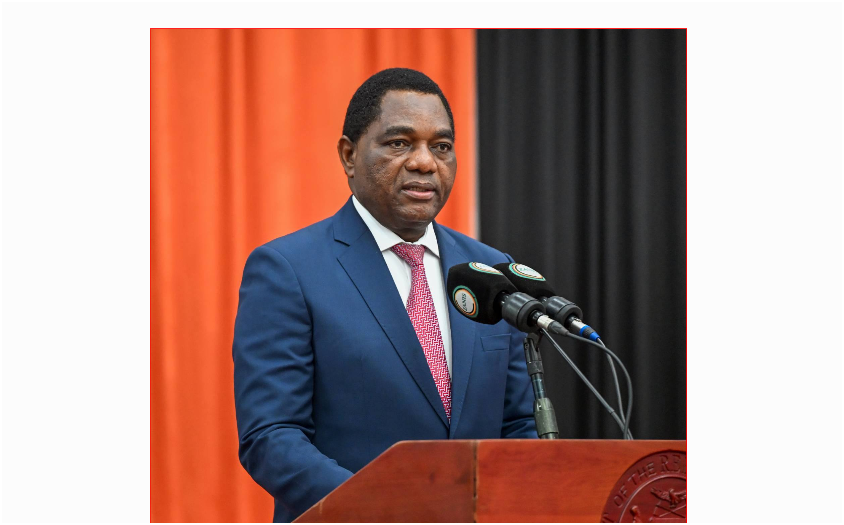
President Hakainde Hichilema has reaffirmed government’s commitment to gender equality and inclusive governance ahead of the 2026 general elections.
President Hichilema says the country has undertaken a series of reforms aimed at dismantling barriers that have historically limited women’s political participation, and aim to create a safer environment for women in both public and political life.
This was said at the gender division-accelerating women’s political participation and leadership conference in Lusaka, where President Hichilema was represented by Minister of Justice, Princess Kasune.
The Head of State noted that government has strengthened protections against gender-based violence through legislative reforms such as the Criminal Procedure Code Amendment Act of 2026 that compels sexual offences to be non-bailable.
“These measures signal zero tolerance for violence, harassment, or discrimination against women. Safety remains a critical factor in enabling women’s full participation,” President Hichilema said.
He added that Zambia’s efforts align with international and regional frameworks such as the Maputo Protocol, the SADC Protocol on Gender and Development, and the Convention on the Elimination of All Forms of Discrimination Against Women, as well as the Sustainable Development Goals, particularly Goals five and 16, which focus on gender equality and strong institutions.
On the political front, the Head of State said that as the country prepares for the August 2026 general elections, he stressed the need for stakeholders to take full responsibility for gender inclusion.
And Mr Hichilema paid tribute to Zambia’s historical female figures that includes Betty Kaunda, Mama Kankasa, Lucy Sichone among others whose contributions to the nation’s independence and development remain influential.
Meanwhile, Electoral Commission of Zambia Chairperson Mwangala Zaloumis implored women not to shun in participating in politics.
United Nations Country Resident Coordinator, Beatrice Muthali said the 2026 general elections will be a litmus test for Zambia’s implementation of gender equality.
Speaking earlier, Non-Governmental Organisation Co-ordinating Council Chairperson, Beauty Katebe bemoaned the low number of women both in political sphere and in decision making positions.
Gender Division Permanent Secretary Mainga Kabika, and Zambia Centre for Interpart Dialogue Chairperson Joyce Musenge also spoke at the event with a clarion call on younger generations to draw inspiration from women that pioneered and actively shaped the country’s future.
And the meeting focuses on key areas of actionable strategies, developing, implementing, and strengthening policies, legal frameworks, and electoral systems to ensure gender inclusion, including promoting 30 percent minimum quotas in political leadership structures.